


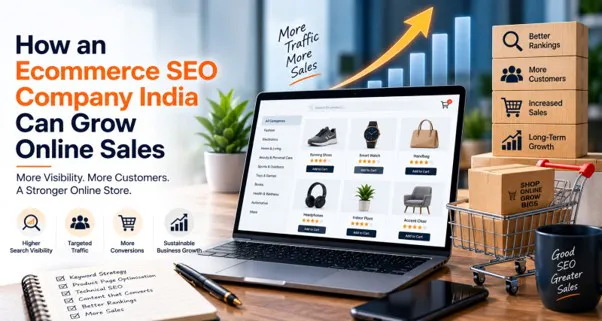
Getting an online store noticed is only the first step. The real challenge is turning visitors into customers.
Can shoppers find the right products quickly? Does the product page answer their questions? Is the website easy to use? Most importantly, do visitors trust the business enough to make a purchase?
This is where ecommerce SEO can make a difference.
A well-planned SEO strategy can help an online store attract people who are already searching for its products. It can also improve important product and category pages, make the website easier to navigate, and create more opportunities for sales.
Working with an experienced Ecommerce SEO Company in India can help businesses connect search visibility with the complete online buying journey.
Start With How Your Customers Search
Effective ecommerce SEO starts with understanding customer behaviour.
Not every search has the same purpose.
For example, someone searching for “running shoes” may still be comparing products. A person searching for “men’s waterproof running shoes size 10” has a much clearer idea of what they want.
These searches represent different levels of buying intent.
An ecommerce SEO strategy should therefore target different stages of the customer journey.
This may include:
- Informational searches
- Product-related searches
- Category searches
- Comparison searches
- Brand searches
- Purchase-focused searches
Informational content can attract people who are still researching. Product and category pages can target shoppers who are closer to making a purchase.
Understanding this difference helps businesses attract more relevant visitors rather than simply chasing higher traffic numbers.
Make Product Pages More Useful
Product pages are some of the most important pages on an ecommerce website.
A good product page should do much more than display a product name, image and price.
Customers may want information about:
- Product features
- Materials
- Dimensions
- Available sizes
- Colours
- Compatibility
- Delivery options
- Returns
- Warranty
- Care instructions
Providing this information clearly makes it easier for customers to make a decision.
Product descriptions should also be original.
Many online stores use the same manufacturer descriptions found on several other websites. This gives search engines little unique information to work with and gives shoppers no additional reason to choose one store over another.
Instead, product content should explain the product in a useful and natural way.
Focus on the questions a real customer would ask before buying.
Optimise Product Titles and Headings
Product titles should be clear for both users and search engines.
Avoid vague titles that do not explain what the product is.
Where appropriate, include important information such as:
- Product type
- Brand
- Model
- Size
- Material
- Colour
- Main feature
The goal is not to fill every heading with keywords.
The title should still sound natural and help users understand the product immediately.
The same approach applies to H1 headings, subheadings, image alt text and supporting product content.
Improve Category Pages
Category pages are often overlooked in ecommerce SEO.
However, they can be valuable landing pages for broader commercial searches.
For example, an online furniture store might have separate categories for:
- Office chairs
- Ergonomic chairs
- Executive chairs
- Gaming chairs
This is usually more useful than placing every product under one general “chairs” page.
A strong category page may include:
- A clear H1 heading
- A short introduction
- Useful product filters
- Relevant subcategories
- Internal links
- Descriptive product names
- Helpful supporting content
Category pages should help visitors find what they want without forcing them to read large amounts of text.
Content should support the shopping experience, not get in the way of it.
Improve Internal Linking
Internal links help both users and search engines discover important pages.
For an ecommerce store, internal linking can connect:
- Blog posts to products
- Blog posts to categories
- Categories to subcategories
- Related products
- Best-selling products
- Product guides
- Comparison pages
For example, a blog about choosing the right office chair could naturally link to the store’s ergonomic chair category.
This gives readers an easy next step and helps search engines understand the relationship between different pages.
Important products and categories should not be buried several clicks deep inside the website.
Don’t Forget Technical SEO
A great-looking ecommerce website can still struggle in search results if search engines cannot crawl or understand it properly.
Technical SEO provides the foundation for the rest of the strategy.
Important areas may include:
- Improving page speed
- Checking mobile usability
- Fixing broken links
- Managing redirects
- Fixing duplicate pages
- Reviewing canonical tags
- Checking XML sitemaps
- Improving website structure
- Monitoring indexing
- Improving internal links
- Adding relevant structured data
Large ecommerce websites often need extra attention.
Product filters, sorting options, colours, sizes and URL parameters can create hundreds or even thousands of similar URLs.
If these URLs are not managed correctly, search engines may spend time crawling unnecessary pages.
An experienced Ecommerce SEO Company India can identify these issues through technical audits and help create a cleaner site structure.
Improve Website Speed
Online shoppers expect pages to load quickly.
A slow website can make the shopping experience frustrating, especially on mobile devices.
Large product images, unnecessary scripts, poorly configured plugins and excessive third-party tools can all affect performance.
Businesses should regularly review:
- Image sizes
- Server response
- JavaScript
- CSS files
- Caching
- Mobile performance
- Third-party scripts
Improving speed can support both usability and SEO.
It can also make it easier for visitors to browse products without unnecessary delays.
Use Reviews and Trust Signals
Customers want reassurance before spending money online.
Trust is especially important when someone is purchasing from a business for the first time.
Useful trust signals can include:
- Genuine customer reviews
- Clear return policies
- Secure payment information
- Delivery information
- Contact details
- Product specifications
- Warranty information
- Frequently asked questions
Reviews can also provide useful insights.
Customers often describe products differently from businesses. Their questions and comments can help identify topics that should be covered on product pages or FAQs.
However, reviews should always come from genuine customers.
Create Helpful Content Around Your Products
Ecommerce SEO should not focus only on product pages.
Helpful content can reach customers earlier in the buying journey.
Depending on the business, content ideas may include:
- Buying guides
- Product comparisons
- How-to articles
- Size guides
- Maintenance guides
- Gift guides
- Product care advice
- FAQs
- Industry trends
For example, a business selling mattresses could publish content about choosing the right mattress for different sleeping positions.
The article could then naturally direct interested readers towards suitable product categories.
This creates a logical connection between content, search traffic and commercial pages.
Optimise for Mobile Shoppers
Many customers browse ecommerce websites using their phones.
That means mobile usability should be part of the SEO strategy.
Visitors should be able to:
- Read product information easily
- View product images clearly
- Use filters
- Select product options
- Add products to the cart
- Complete checkout
Buttons should be easy to tap and navigation should be simple.
A mobile page should not feel like a smaller version of the desktop website. It should provide a smooth shopping experience on its own.
Connect SEO With the Buying Journey
SEO should not operate separately from conversion optimisation.
Imagine a visitor finds a product through Google and lands on your website.
The page ranks well, but the customer cannot find:
- Delivery information
- Available sizes
- Product details
- Return information
- A clear Add to Cart button
The ranking has generated a visit, but the website has not helped the visitor move towards a purchase.
A stronger strategy connects SEO with:
- Website navigation
- Product presentation
- Calls to action
- Trust signals
- Mobile usability
- Checkout experience
Traffic matters, but what happens after the click matters too.
Target the Right Keywords
High search volume does not always mean a keyword is valuable.
For ecommerce websites, commercial relevance can be more important than volume.
A broad keyword may attract many visitors but few buyers.
A more specific keyword may have lower search volume but stronger purchase intent.
Keyword research should therefore consider:
- Search intent
- Product relevance
- Competition
- Search volume
- Customer stage
- Commercial value
This helps businesses focus on keywords that can support both visibility and sales.
Measure More Than Rankings
Higher Google rankings are useful, but ecommerce businesses ultimately need sales.
Ranking reports alone do not tell the complete story.
Businesses should also monitor:
- Organic traffic
- Product page visits
- Category page traffic
- Add-to-cart actions
- Conversion rate
- Ecommerce transactions
- Organic revenue
- User engagement
- Landing page performance
These metrics provide a clearer picture of what SEO is contributing to the business.
For example, a keyword may move from position 10 to position 4. That is useful.
But if the page also starts generating more product views, add-to-cart actions and sales, the improvement becomes much more meaningful.
Keep Improving the Website
Ecommerce SEO is not a one-time activity.
Products change. Competitors launch new pages. Search behaviour evolves. New categories may be added and old products may go out of stock.
SEO should therefore be reviewed regularly.
Businesses can continue improving by:
- Updating important product pages
- Refreshing category content
- Fixing technical issues
- Improving internal links
- Updating old blog posts
- Reviewing search queries
- Monitoring competitors
- Analysing conversion data
Small improvements made consistently can build stronger organic performance over time.
Building Sustainable Ecommerce Growth
Organic search can become a valuable source of traffic and sales when SEO is approached as an ongoing strategy.
The goal should not simply be to attract as many visitors as possible.
A better goal is to attract the right visitors and give them the information they need to make a confident purchase.
Antops Technologies India helps ecommerce businesses improve their search presence through keyword research, technical SEO, content optimisation, internal linking and performance-focused strategies.
As an experienced Ecommerce SEO Company in India, the focus is on connecting search visibility with a better shopping experience.
When SEO, content and usability work together, an ecommerce website has a stronger opportunity to attract relevant shoppers and convert more of them into customers.
For an online store, successful SEO is not simply about being found.
It is about being found by the right people, helping them find the right products and making it easier for them to buy.
Related Posts

Do-Follow Business Listing Sites in the USA for Better Search Visibility
Getting a business mentioned across the web still matters, but successful off-page SEO is…
Best Do-Follow India Listing Sites for SEO and Backlinks
Introduction Building a strong online presence requires more than just creating a website and…
How the Best SEO Agency in India Builds a Long-Term SEO Strategy
SEO can sometimes look like a collection of individual tasks. One page needs optimisation,…
Indian SEO Company vs. Freelance SEO Expert: Which Is Better?
When a business decides to invest in SEO, one question usually appears quite quickly:…